Effective communication on board
by Ken Gillstrom on 24 Apr 2015
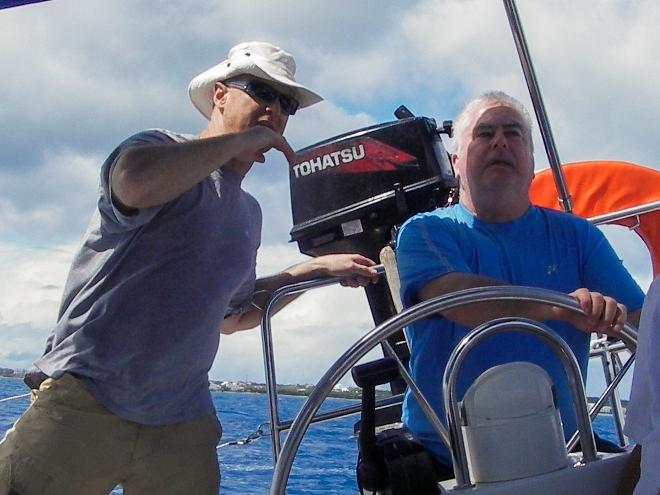
Effective communication on board Ken Gillstrom
In all aspects of our lives, communicating is an essential skill that we use to make friends, build relationships and carry out everyday functions at work and play. Everyone has their individual style of communicating, some people being more effective at it than others. Your ability to communicate can determine how successful you will be to maintain relationships or progressing through the ranks in the workplace. Rarely does this ability or lack of it become life threatening. If the communication process breaks down, we can retreat to another room, office or even get away from the situation . . . and life will go on.
At sea, the situation is very different. Your safety, along with the safety of crew and vessel, is dependent on how well people communicate on the vessel. Not only the safety concerns, but everyday life on the vessel can be “awkward” if the communication process breaks down. There is nowhere to retreat to or get away from the situation – the issues are full front and center. Using the wrong wording or a “perceived” improper tone can easily lead to mutiny. Appropriate communication on the vessel will not only make it safer and maintain an amicable attitude amongst crew, but will also make daily life much more pleasant.
Communication is the process of exchanging information, knowledge, emotion and understanding between parties. This process can be executed in three ways.
One way communication
Transmission from sender to receiver with no desire or intention for feedback
Fast, simple instructions
With no feedback, we are unsure if the message was heard or understood
The crew may not hear the full message or misinterpret it, resulting in confusion. This misunderstanding will leave both parties frustrated and stressed.
Two way communication
Transmission of information back and forth between parties
This process requires more time
You receive feedback that helps you determine whether the message has been received and interpreted properly
If the message has been misunderstood, the person delivering the message will know this immediately and they will have to transmit the message again, with increased volume or different choice of wording.
Non-verbal communication
Transmission of information and feelings through gestures and body language
Non-verbal communication may be the only way to transmit your message, if there is a lot of background noise or a substantial distance between the two parties, as can often be the case when we are at sea.
If we combine non-verbal methods with a verbal message, we will increase the impact of the transmission and it may be deciphered and understood quicker than a verbal message alone. A watch captain’s verbal message to raise an anchor can be enhanced by pointing up and rotating the hand.
However, if we are utilizing two ways of transmitting a message, we must make sure that they are in sync and delivering the same message. Otherwise, the recipient will get mixed messages and confusion results.
Focusing on two-way communication is the key to increasing safety on the vessel.
Use standard, known, and agreed upon phrases to simplify the process and reduce the chances of confusion
- Ready to tack
Listen for ALL to respond to ensure the message has been received, decoded, and the recipient is ready to act on the message
- Ready
If feedback is not received or the feedback is not relevant to the expected response, then the message must be repeated. You may have to enhance the message using more volume or gestures. Remember that you are in a noisy environment and it can be difficult to hear.
Try to make eye or physical contact during the communication process. This will improve awareness and effectiveness of the message.
Effective communication on board, a vessel also relies on crew members being good listeners. They must be attentive in order to receive and decipher the complete message, as well as make the speaker feel heard and understood. If the audience is not focused on the speaker, only part of the message is received, resulting in frustration and hostility in both parties.
On beautiful sunny days at sea, with the moderate wind on the stern quarter, life on the vessel can be pure bliss. However, a small change in weather conditions, or a mechanical failure can increase the stress levels on the vessel, putting the emotional atmosphere on the vessel into a tailspin. This is when effective communication is required the most, but the increase in stress usually reduces our ability to transmit messages and listen effectively. This in turn leads to a misinterpretation of the message and friction builds between the parties.
If the physical environment (weather/mechanical breakdown) continues to deteriorate, emotions will run high and possibly get out of hand. The communication process becomes disrupted and can completely break down. Crew relations and safety will be jeopardized.
This is a time when effective communication needs to be at its peak so all crew can work as a team. Quite often, changing environmental conditions require quick thinking, problem-solving, and creative ideas. If the crew is communicating well with each other, they will remain focused, allowing ideas and solutions to flourish.
No two crew members are wired the same, each one communicates in their own way. When faced with stressful situations at sea, my brain sparks and my concentration goes into overdrive. Along with this, my communication level focuses on providing only essential information to crew. I only want pertinent information communicated to me. On the other hand, Carol becomes much more verbal in these situations and also wants every fragment of information communicated to her so she can analyze and process it in her mind, to fully understand the picture.
These completely different processes work for each of us; however, we need to co-exist and even thrive, in these stressful situations. Carol is looking for increased amounts of communication from me at the same time that I am clamming up, trying to concentrate. We have come to realize these differences and make a purposeful effort to accommodate each other’s communication style, reducing the chances of conflict.
There are also situations where crew members need to react very quickly. An approaching hazard may require immediate response to commands and there may be little time for two-way communication. The “order” comes across urgently and the crew needs to react with speed and precision. It will be the tone of voice and the volume that will demand the appropriate response. Many times, it is just this tone and volume that gets the backs up of crew members. Therefore, in the general day-to-day running of the vessel, communication needs to be clear and concise, involving participation from both parties. This takes time and quite often a concerted effort.
The “Captain Bligh” type commands must be reserved for those very few (hopefully never) imminent situations when response time is critical to the safety of crew and vessel. If crew members understand that this is the communication style used on the vessel, they will respond to the Captain Bligh order urgently, without hesitation nor getting their backs up. If the Captain Bligh style is used too often (more than once), then crew will not know which situation is critical and safety will suffer, not to mention there will be degraded morale on the vessel.
There are other situations on a vessel that are not conducive to effective communication – anchoring and docking come to mind. These can be stressful situations because at the same time the parties are trying to communicate, they are focused on their individual task. The crew members are separated by some distance, background noise levels are high, and there is little or no eye contact. That is, everything that you need for communication to be effective is removed from the equation! In these cases, it is important to come up with a plan of action and communicate it with the crew prior to entering into the situation. Sort of like a huddle in football, or a morning strategy meeting at the office. A plan of action is communicated and all parties are assigned a task. There may even be a Plan B discussed. This means that there is less information that will have to be communicated when completing the assignment and crew members can focus on their individual, preassigned tasks.
Communicating on the radio offers its own challenges. The only tool we have to get the message across is our voice; no gestures, expressions or eye contact. Most times we cannot see the recipient, or even know that they are there. The recipient has their own challenges . . . static, poor reception, and background noise. There may even be a language barrier. They don’t know you, see you or even know where you are. In radio communication, you only have the tone and volume of your voice to get your message across.
In this case, you must use carefully chosen words to give the recipient a true picture of your situation and avoid any confusion. You need to understand the recipient’s challenges and help them overcome them by speaking slowly and clearly, enunciate every word and pause between them. The only way that you know that they have received and understood the message is to have them repeat it back to you. Since you cannot see them, you will know if they are taking action or what their response is unless they tell you so, you may have to deliberately ask them.
On our last day of an Atlantic crossing, the radio crackled away with a MAYDAY. The male voice had a heavy accent, but the basic message was clear “Meyday-Meyday-Meyday dis iz . . .” We quickly responded and asked them to repeat the nature of emergency and location, as it was difficult to decipher the heavy accent. A new English female voice came over the radio: “100’ wood schooner, five crew on board, engine room is on fire, all electrical and mechanical have failed, life raft has been launched”. Her voice made it obvious that the situation was urgent and they feared for their lives, but no sign of panic. This enabled her to communicate clearly. They were only seven miles away and making a course change to Barbados under full sail.
For the next eight hours, we provided an escort to the vessel, in case the situation on the vessel deteriorated to the point where it was necessary for them to abandon ship. We shadowed them, as they were a faster vessel, never getting closer than four miles and never gaining visual contact. However, we could vividly see the vessel and crew in our minds. The communications officer on the schooner had an incredible ability to stay calm in an emergency while keeping us aware of the situation, and to make sure that we there for them if needed. We continually gave reassurance that we were with them, but their handheld VHF died after seven hours. The Barbadian Coast Guard had monitored all communication and intercepted the schooner 20 miles from the coast, at which point the Coast Guard gave the okay to break off the escort.
As we are a teaching vessel, we have witnessed many different personalities and communication styles while at sea. Some styles definitely prove more effective than others. Quite often, the style of communication you use will be different for various crew members, depending on their personality or their relationship to you. Crew members must make an effort to overlook challenging personalities and respectfully interact with each other.
Effective communication is one of the key factors that helps create and maintain a safe environment on and around your vessel. This will not only make for safer voyages, it will maintain an amicable crew, and miles of pleasant sailing.
If you want to link to this article then please use this URL: www.sailworldcruising.com/133658