Debbie says there are 7Ps and 1C with Insurance
by John Curnow on 5 Apr 2017
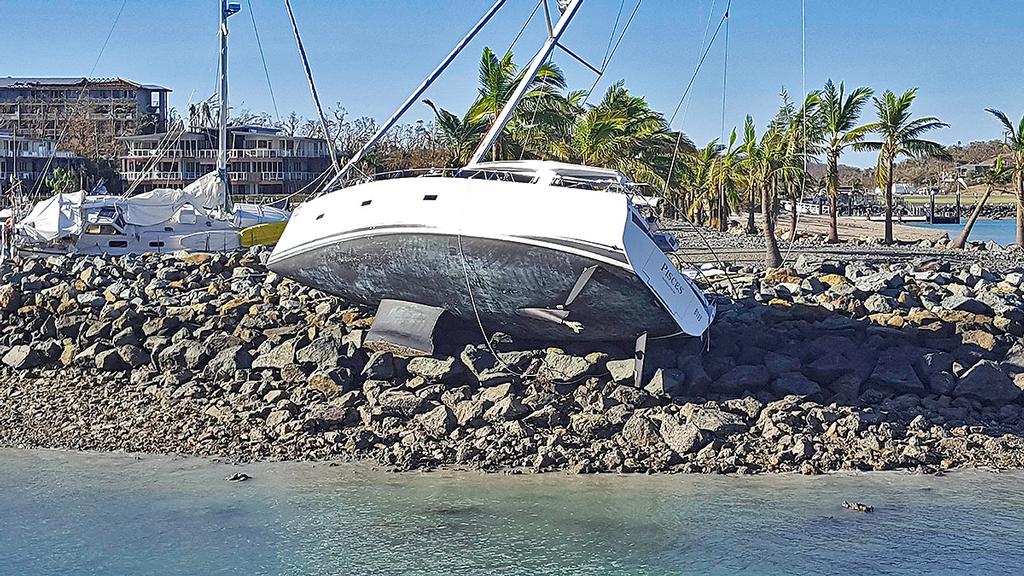
Let's just say that this lovely Moody did not get there under Diesel. SW
If you have been on the planet or around boats long enough, you’ll know all about the 7Ps. The one ‘C’ mentioned here refers to consequence, and in the legalese that surrounds insurance, it gets applied distinctly to consequential damage. We’ll come back to all of that in a while, but for now, our mission is to look at the consequences of actions prior to TC Debbie making landfall.
There can be no doubt that the cost to the community at large of her awesome power is huge, and possibly still to be totally comprehended. She caused pain and will continue to do so for months, as people rebuild lives and business. That the human fatality count was so small is a blessing, and one we should all be very thankful for.
Now the cost in terms of marine pleasure craft insurance claims is yet to be totally ratified, but with some experts putting $25M into the mix, it gives you some idea of the final quantum. So the consequence of this will no doubt be higher premiums for some, yet it should not necessarily have to be so; at least in part.
There is plenty of material out there about how to prepare for these events, because they are not that uncommon. In a way, it all goes back to Tracey, but in the digital age, you do not have to hope the telegraph poles stay up in order to learn what happened.
Those who arrived first after the fact saw how little preparation some had done. Some used the excuse of living in one of the Southern States. Others just said, ‘I did not know.’ So prepare your chin now, for these are not valid. We knew five days out what areas were likely to get walloped. Early on we thought Debbie may only remain as a Cat1 storm, but her intentions were revealed smartly. At this point we need to thank all the scientists and mathematicians who have given us such accurate models to work with.
Right then, here it is. There were people on the ground that could prepare your boat if you could not, and early in the piece there was that all-important asset on hand – time! There is an onus. There is a responsibility, and it lies squarely with you, the insured. Your insurer is in partnership with you, but in reality, would you expect a partner to remain beside you if you were negligent. If it was business, you’d fire them. And if it was contractual, you would begin litigation.
Honestly, what did you think was going to happen? If you have a trailer on the back going down the highway at 100kp/h and you get hit with a crosswind, then it can almost make you change lanes. Fact. Debbie had a peak gust of 263kp/h, which is way more, and its effect is geometric in terms of windage.
Now exactly that is the point. Even a 52-foot racing boat with inherent high stability and a 3.35m keel will heel 5-10? in 55 knots, and that is with bare poles and tied up in a marina! In the Caribbean they chain down the boats in cradles on the hardstand and take out the sticks when hurricanes are expected.
So why is it then that yachts were left with furling sails on the forestay, boom bags over the main and boom, with all those rags just dying to sneak out and have a party with Debbie? If you are pre-feeding the kite out of the bag, you always wait to the last minute, you wool the tack, and that is only in 20-30 knots, not 142!
Yet this is not just the sailors lament, for boaties left clears, covers and biminis up on all manner of cruisers. Up 25 feet in the air, what kind of windage did you think the clears around the flying bridge were going to create before they blew out? What force goes onto your cleats, those on the quay, as well as all the bolts and fittings that hold the marina together?
Fact is, at Hamilton Island, a lot of the damage done to vessels was caused by other, ill-prepared craft that blew off, warped fingers, or twisted around inside their own pens. By and large, the vast majority was preventable, and the consequence (yes, that word reappears again) is that you may well be faced with your insurer not paying for things like sails, biminis and covers, for these are the very items that caused the issues.
The consequential damage, like running up on the bricks will be part of a legitimate claim, but if you caused the problems by not preparing your craft, then expect that they may say ‘No’ to the very things you left on deck. Equally, consider those whom your craft affected. The way the law works, in a natural disaster, an insurer cannot cross claim against another. It is a case of everyone looks after their own. That’s fine, but you inflicted pain on the other, and now they have to deal with it, and also cop a premium hike to boot. Hardly fair, wouldn’t you say?
You can take it another step and say what should you do. Well if you are in a cyclone rated marina, you can put new lines on, not old, UV affected garbage, but real lines, even chain to properly distribute the load over multiple points on both boat and quay, remove furlers and all sails, including anything that will attempt to become one of those the moment the wind gets up. Cushion the force that will be applied onto the topsides with multiple and suitable fenders. Remove anything that will become a projectile and stow it below, because in that sort of breeze a straw will become an arrow.
You see, the notion that insurance will take care of it all is not entirely correct. Many could soon be finding out that some of their claim is being rejected, where it pertains to sails, covers and so on that were left out.
In the partnership, you do have responsibilities. They stem from basic seamanship, and wanting to look after your asset.
Ultimately, every boat owner is going to pay, for insurance companies are to be profitable business, not mutual benefit societies, and in that way ask yourself if you are happy to be putting money into the pockets of the lazy? If it were a government department handing out free money there would be outcry, but the parallels are there, so think seriously about your own situation.
Ultimately, this is about education, not whacks over the knuckles with the metal ruler. There is time to prepare and there are people around to do it for you, should you not be capable, or able yourself. Technology is a marvellous thing and this case, so, so easy to utilise to your benefit.
When your premium goes up, maybe ask yourself, ‘Am I prepared to take responsibility for my asset and the consequences of not implementing safe seamanship and common sense?’ If you are, then next time, you will find yourself in whole different situation, and not have claims rejected based around negligence, laziness and consequential damage. For in the end, is it not better to spend the time preparing and then cleaning up afterwards, than it is to have to drag the boat off the bricks, repair or replace it, and maybe endure years of costly and time wasting litigation? Simple maths in the end, you would think, and that could well be the best consequence of some due diligence and careful application of a few Ps. Nice…
If you want to link to this article then please use this URL: www.sailworldcruising.com/152840