
Hurricane Force
by Tom Cunliffe 1 Feb 03:40 UTC
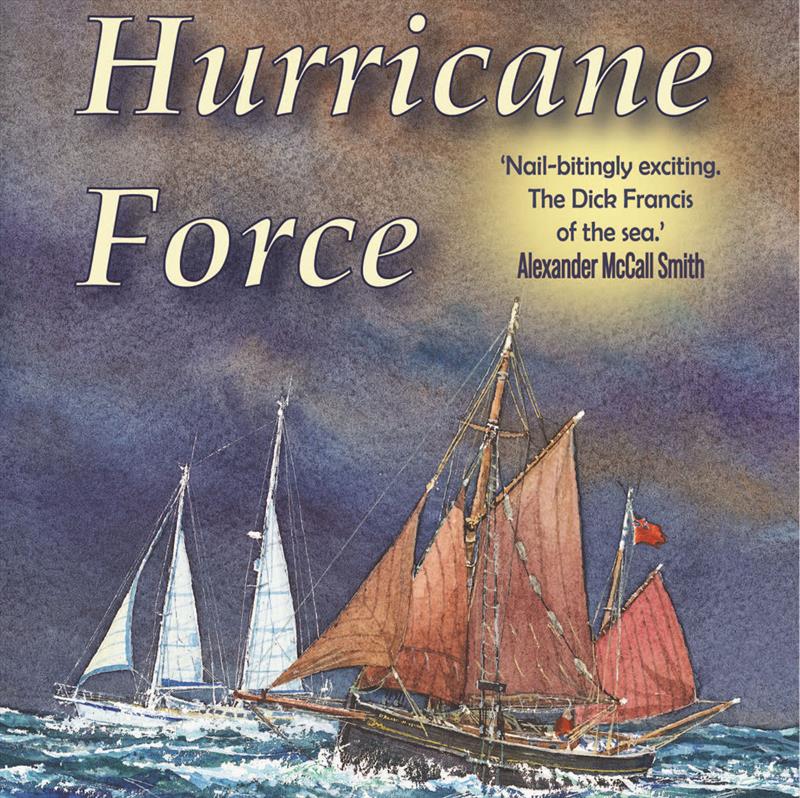
Hurricane Force, Tom Cunliffe's novel, with cover painting by Colin Baxter © Tom Cunliffe
Last year I overheard one sailor say to another, 'About time Cunliffe wrote a novel...' Well, after 25-odd technical books, I have.
Hurricane Force is not any old book - it's had rave reviews, including one from well-known author, Alexander McCall Smith, who has hailed me as 'the Dick Francis of the Sea', and says the novel is 'nail-bitingly exciting'.
The book should really come with a government health warning as once you start reading it, you won't be able to put it down. It may completely rob you of your sleep.
About the Author - Tom Cunliffe
Tom Cunliffe is one of Britain's leading writers on sailing and the sea. He was educated at the University of Liverpool where he read law. Since running away to sea in 1968, he has worked on vessels of all sizes from dinghies to large gaff schooners. He has served in small sailing ships, been to sea as mate on a coasting merchant vessel and taught sailing, seamanship and navigation at every level. He is an RYA/MCA Yachtmaster Ocean Examiner and has worked as a consultant for US Sailing.
In his own yachts he has cruised to destinations as diverse as Brazil, Greenland, the Caribbean and Communist Russia. Specialising in vintage and classic craft, he is a world authority on gaff rig. He has delivered two major BBC TV Series and his Youtube channel has 40,000 subscribers. He has written over thirty published books, including two Best Book of the Sea award winners.
After 40 years of owning wooden, traditional yachts he now goes to sea in his 44ft classic US-designed bermudan cutter. He lives with his wife in England’s New Forest where he maintains a 1949 Bentley and cultivates roses.
About the book - Hurricane Force
Ian Hordle is a Merchant Navy deck officer whose world has been capsized by events on a global and a personal scale. To turn things around he buys a converted fishing boat as a home and a magic carpet. Sailing west from England in the 1970s looking for a new life while trying to make sense of the old, he is alone in the Atlantic when a rogue container holes his boat and throws him into a pivotal battle to save himself. There can be only one result if he fails.
Somehow, he keeps her afloat and limps into a small island in the Caribbean hoping to find a repair yard, but things are not what he expects. Dark forces are threatening a unique wildlife balance and decent local people are being thrown out of their homes to make room for a holiday development. Ian is soon drawn in, but it isn’t long before his unusual seafaring skills make him the target of something much worse. After an eco-warrior friend is murdered, he is caught in a trap of evil from which there seems no escape. The resistance movement against the incoming tide of greed includes a calypso singer, the skipper of an island schooner and a feisty young lawyer committed to much more than just the paperwork.
With his boat seaworthy once more, Ian cannot run because conscience and a growing attachment to the lady demand that he joins the effort to save the community. He is walking a tightrope. If he stays, there are people who want him dead.
Surrounded by sharks on land and sea, his situation seems hopeless. So does the future of the island, but Ian is a seaman to the core. With the elemental madness of a hurricane homing in, can he save the community, the pending environmental mayhem and even his own life?
How does a technical author change gear and write a successful novel? With extreme difficulty, some might say, but not Tom Cunliffe.
Hurricane Force marks a milestone in the work of the best-selling technical writer of thirty-plus books on seamanship and navigation that have enlightened generations of sailors. His historical work on pilot craft under sail has brought him world renown and his travelogues about North Atlantic voyaging and motorcycle riding in the USA have entertained a wide readership.
A novel is a different proposition. However distinguished a non-fiction writer may be, pulling off a thriller takes him into foreign country where legions of human brigands and natural pitfalls wait to pull him down. Many have fallen, but not Cunliffe. The book has clearly been plotted with meticulous care, the tricky business of writing direct speech has been handled like a master, and the scene in the 1970s Caribbean is eerily accurate. So real are many of the characters that it’s hard not to think they must have been drawn from real life. The descriptions of triumph and disaster under sail are spot-on and the steadily accelerating pace of the narrative makes the book hard to put down.
Author's Statement
I started to write this book back in 1985 after two winter seasons in the Eastern Caribbean, before the development of the last forty years had begun. It was refined and finished at sea in summer 2025 after being unearthed from a dusty drawer. The scene and many of the characters are developed from my own experience. Some of the more extreme events driven by natural forces actually happened to me or my friends.
Once the hard work of plotting was managed, writing the book was a huge pleasure. I am already working on the sequel.
In the excerpt below, Hordle has saved his boat after a catastrophic collision with a shipping container in mid-Atlantic. He is nursing her into a remote island where he hopes to find repair facilities backed up by an old shipmate, Ralph Fisher, who now runs a small hotel nearby.
Excerpt
Daylight was fading as Dream of Olwen swept past the northwest corner of Rogation into the calmer seas on the leeward side of the island. The wind was bending around the small volcanic peak that stands plumb in the centre, giving us a fair breeze past Two Mile Beach, the palm-fringed strand that runs the whole length of the sheltered west coast to the north of Union Cove. The ocean turned from blue to a pale, translucent green as the white sand bottom careered by forty feet beneath us. As the distinctive palm grove at Union Cove came in view, everything was as I remembered it, and shortly afterwards we sailed into the flat water of the cove itself. The wind had been easing for the past hour and Dream glided to a standstill on its dying breath, her keel just scraping on the bottom.
Fifty yards away the cradle stood empty. I could see in the twilight that something about the yard had radically altered, but it was too late to worry about impressions now. Dream lay quiet at last, a boat’s length from the beach. I anchored her stern, moored her bow to a pair of handy palm trees then, as an afterthought, I rigged her heavy timber beaching legs so that the bilge water could rise to the waterline if it chose, yet the boat would not fall over and fill. They’d been a nuisance on deck. Now they could earn their keep.
From somewhere behind the fringe of palms came the sound of voices half-drowned by the strident beat of calypso on the inevitable megawatt beach-blaster. I relaxed for a few moments in the rough comfort of the saloon berth, reflecting on how far the music had moved on from the days of Harry Belafonte and ‘Island in the Sun’. The endless noise and motion of the sea were gone. Somebody replaced the heavy calypso with softer reggae music and it was so peaceful down below that the steady trickle of the water leaking into the focsle was clearly audible. The sound didn’t bother me any more. My needs were simple now. From far away the recorded voice of Bob Marley filtered through the open forehatch:
‘Let’s get together and feel all right.’
I hoped it was a good omen.
-----------------------------------
‘Hey, Skip! Wake up!’
Sunlight was flooding into the cabin as I carefully opened one eye.
‘Glad you’re awake, Skip. Thought maybe you was dead.’ My visitor was wet from swimming to the boat. I sized him up. Back in the days before tourist yachting, Caribbean anchorages were well stocked with likely village lads ready to help out in exchange for a fairly honest dollar. This one had all the hallmarks - about four feet tall with shining morning face and choirboy trimmings; perfect oversized teeth, short crinkly hair, a cheerful grin and bright eyes that looked straight at me. His bare feet were ankle deep in bilge water. Since there was no noise of the sea running into the forward part of the ship, I concluded that the level inside was now the same as outside. Dream was therefore technically sunk, but she was still sitting bolt upright on her legs.
‘Morning, Sunshine,’ I croaked. ‘What’s your name?’
‘I’m Winston,’ came the unlikely reply. ‘You hungry, Skip? You need fresh eggs, grapefruit, breadfruit, passion fruit?’
‘I’m hungry, Winston,’ I interrupted, ‘but I don’t need any of that right now. Just you hop up into the cockpit and start pumping. If you’ve cleared the bilge by the time I’ve had my coffee, there’s one dollar for you. We’ll take it from there.’
‘Yessir, Skip,’ piped the lad, and splashed up the steps. As I began paddling around the galley the clank of the pump started spasmodically, stopped, began again, then settled down to the rhythmic stroke of a determined man at work. Maybe Winston and I were going to get along.
By the time I’d downed an instant coffee and half a dozen emergency crispbread biscuits the water was below the cabin sole. Once again the noise of the leak was evident. The regular pumping had slowed down, but young Winston hadn’t given up. He was either in desperate need of that dollar, or he’d inherited some of the characteristics of his famous namesake.
‘That’ll do,’ I called. The ship’s clock read midday as I opened it up to grab a handful of money from the stash inside the case. The average boat burglar never thinks to look there. ‘Good work on the bilge. Now I need to find the foreman of the boatyard, then you can run me an errand. When you’ve done that, I’ll give you two dollars, not one.’
‘Railway’s shut down, Skip. You wasn’t wanting to haul was you?’ He stopped smiling for the first time since he’d come aboard.
‘Shut down?’ I ignored the provocation to state the obvious as my hopes hit the cabin sole.
‘Yessir, Skip. It’s due to be bulldozed soon for the new hotel buildings. Bar’s going too,’ he added, ‘and most of the village.’
I poked my head out of the hatch for the first time in full daylight. Things had seemed vaguely out of place through my fatigue of the previous evening. Now, with the sun shining harshly, Union Cove looked like a bomb site.
A short way down the beach a bulldozer was attacking a particularly attractive coconut grove. The area around the boatyard itself was littered with the usual debris of a construction site, while a gang of workmen were erecting what looked like a pair of large mess-huts.
On the one hand, the scene spoke for itself. On the other, the railway was still intact and looked more than capable of hauling my boat. If the work were done efficiently Dream could be put to rights in a couple of weeks, so the idea of hauling just one more vessel appeared reasonable enough. Besides, I had no choices left. By sailing downwind as far as Rogation I’d committed myself to a repair on the spot. Running to leeward had been workable, but thrashing back upwind as far as Martinique or St Lucia was a non-starter. Even the hundred-odd miles down to Grenada would involve crashing into the seas against the eternal current. Dream would never make it.
‘Who owns the yard, Winston?’ I came to a decision.
‘King Solomon, but…’
After all my commercial visits to the Islands, odd names were not new to me, but this one took the biscuit.
‘King Solomon?’
‘Sure. He’s the big man round here. He’s boss of the yard, and he keeps the bar on the beach.’
‘All right. But why the handle?’
‘He got that back sometime when he was calypso king of the Leeward Islands, when him and my dad were young.’
‘It’s not his real name then?’ I asked superfluously.
‘It is now. It ain’t the one his mother gave him, but when you’re champion calypso man, you choose a name, then you keep it. King Solomon, he was a wise man back in Bible time. Solomon down there, he’s wise too. He can build a schooner, even train a horse. Ain’t nothing he can’t do.’
‘Take me to him.’
Winston’s brow furrowed with concern, but he’d slithered down to the dinghy and manned the oars by the time I had lowered myself into the stern. He rowed me the forty feet to the sand while I sat in splendour like the Cambridge cox at the Boat Race.
We were just stepping ashore when the ordered toil of the hut builders broke up in noisy confusion. There was a raucous argument, work stopped and one newly assembled section of wall tumbled to the ground in a cloud of dust. The performance was being observed by a white man who reminded me of a weasel, and a giant, athletic-looking local.
The weasel waited for a few seconds, then spoke to his companion, who ambled over to where the trouble centred around two men. By now diplomatic relations had been severed and the protagonists had arrived at the barging stage. The rest of the crowd had downed tools to enjoy the fun. Judging by the rapidity with which public support split down the middle, the difference was well-known and of long-standing.
The first punch flew a split-second before the bouncer arrived, but it was the last. He grabbed one of the troublemakers by the hair and collared the other by the back of the neck, drew them slowly apart, then rammed their heads together with awesome violence. They went down like bullocks in a slaughterhouse and their supporters showed no interest in helping them up.
After a moment of stunned silence, the troops returned to work with understandable enthusiasm, leaving the luckless hard cases in a heap on the sand. As he ambled back to the weasel, the big fellow slowed to stare hard at me and harder at Dream, then he walked on to catch up his chum, who was already marching away towards the centre of the island.
At the head of the bay, half-hidden in the palms, was the beach bar which was the origin of last night’s music. Calypso was again thundering out, though the only modern technology in sight was the hi-fi and the beer cooler. It looked as though King Solomon had been getting some things right.
The bar was full of lunch-time drinkers, mainly locals but with a sprinkling of Europeans.
We stopped at the edge of the crowd and I pressed a ten dollar bill into Winston’s tough little hand.
‘Get me a beer; grab yourself a coke, take a dollar on account, and bring me the change.’
He dived into the throng and I leaned against a wooden upright in the shade of the split-cane awning. In the corner behind the bar stood a heavily built black man well on in years. As I watched he was confronted by a sandy-haired character in need of a bath whose most notable feature was that he’d obviously lost an argument with a windscreen. I recognised him as the weasel, and judging by the other’s expression, he was not a welcome caller.
The tête-à-tête was soon interrupted by someone operating below the sea of heads. A heated exchange of words took place, both men looked in my direction and a few seconds later Winston’s arm appeared in their vicinity, apparently doing business with the barman. Soon he materialised once more at my side, handed me the beer, and counted out the change.
‘That’s King Solomon by the bar. He’s with Mr Scriven, the foreman,’ he announced. Then he continued blandly, ‘And he says he can’t repair your boat.’
I looked skywards in search of strength.
‘I only asked you to show me who the guy was, Winston,’ I groaned. ‘You weren’t supposed to negotiate for me as well.’
‘That’s all right, Skip,’ he replied, unabashed. ‘I know everyone round here. I’ll look after you.’ But I’d had enough of Winston’s diplomatic initiatives for one day, so I poured the Carib down my throat, sent him off to find Ralph Fisher, then strolled disconsolately over to inspect the hauling-out facilities it appeared I wouldn’t be using.
I was reflecting that I wouldn’t be the only one sorry to see the end of this tight little yard, when my gloom was interrupted by King Solomon himself.
‘There’s no use you staring at my railway, Cap,’ he said. ‘The last boat came down a week ago and there won’t be no more.’
Close up, he was taller than he’d appeared earlier. His outfit was loose but not untidy and his face was deeply lined without conveying the impression that he’d spent his life worrying. His eyes were quick, remarkably bloodshot and they were giving nothing away.
‘Anyway, what’s it to you? You can get hauled any place in the Islands.’
‘Come and have a glass of rum on my boat. And I’ll show you what it is to me.’
To my surprise he agreed. On the way I told him about the accident. Once aboard Dream, I poured him a half-tumbler of Mount Gay and led him down to the focsle. When he saw the extent of the damage largely hidden from the outside by my makeshift repair, he whistled softly.
‘Sure wasn’t your time to die out there, was it?’ he grunted.
I thought I detected a flicker of sympathy, but he wasn’t changing his position. We were still talking around the subject when a bump alongside announced the arrival of Ralph Fisher in a borrowed dinghy. He’d wasted no time. Neither had Winston for that matter.
Ralph swung down into the cabin. Bronzed, good teeth, Mexican moustache. He was at the age where his lifestyle ought by rights to have thickened him around the waist, but he looked as fit as the last time I’d seen him. He didn’t mince around the point of his visit. After exchanging greetings with both of us he made his own inspection of the damage to Dream, then he sat down in the saloon and poured himself a shot.
‘When’s the railway scheduled for demolition?’ Fisher cut to the chase.
‘Sometime this week. The foreman’s just laid it on me.’
‘How long would it take to fix up this boat?’
‘Ten days, maybe.’
‘Right, then,’ continued Fisher. I wasn’t sure that I liked the sound of what was coming next, but there was no choice. ‘If you dig your men out of the bar, haul the boat and start working, with luck you’ll be finished in time. If you aren’t, there’s no way anybody’s going to shove the boat back into the water with half her planks off. They’ll just have to wait.’
Solomon saw the logic of this, but he still resisted.
‘You’re not involved with these guys over on your side of the island,’ he said quietly. ‘You haven’t seen what they do with folks that get in the way, and maybe you don’t know it, but they’re in a fired-up hurry about something too.’
But for all his protests, Solomon was weakening. It must have jarred against his island mentality either to refuse a ship in need or to turn away captive business.
‘So you’ll just lie down and do what you’re told?’ Ralph continued turning the screw after a long pause. ‘And let this man drown himself trying to beat up to Martinique in a boat with a damn great hole in the bow.’
Once more silence descended while the old man served himself another dose from my bottle. He drank deeply, then he looked down at the cabin sole between his knees. For a while he appeared to inspect it in minute detail, then the rum prised his better self out of him and he slapped the table with the palm of his gnarled hand.
‘Okay,’ he said. ‘Let those bastards go to hell. We’ll do the job.’