
Vuelta Vertical reaches the Pacific Ocean after 37 days and 5,800 miles in extreme latitudes
by Vuelta Vertical 3 Apr 18:50 UTC
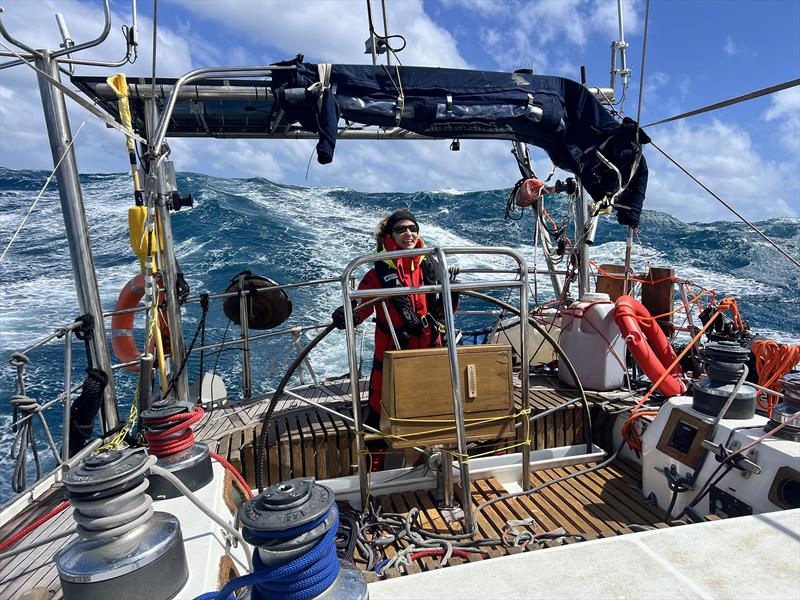
Copia de Paula © Vuelta Vertical
Vuelta Vertical, a sailing circumnavigation connecting the world's two polar regions, reached the South Pacific phase of its voyage on 27 March at 17:50 UT, after completing 5,800 nautical miles from Cape Town, South Africa, aboard Alegría Marineros, a 68-foot custom aluminium yacht. The expedition is led by offshore sailors and captains Paula Gonzalvo and Pedro Jiménez.
This leg took 37 days with seven crew on board, mainly between 47° and 48° South, in one of the most active low-pressure corridors on the planet. During the passage, the yacht sailed in sustained winds of around 35 knots, with gusts up to 63 knots, average seas of 3 to 4 metres, and a maximum recorded wave height of 6.5 metres.
The daily weather strategy, led by Paula Gonzalvo and Pedro Jiménez has been to skirt the lows on their north-eastern quadrant, using favourable wind while staying out of their most severe sector. That tactical discipline has allowed the yacht to keep moving safely through a demanding stretch of the southern Indian Ocean.
As of 30 March at 12:00 UT, Vuelta Vertical had already logged 17,030 nautical miles in 136 days since departure, linking the Mediterranean, the Atlantic, the Antarctic region, the Indian Ocean, and now the South Pacific. The next landfall is expected in Valdivia, Chile, around 3 May.
Beyond the sailing itself, one of the defining aspects of this leg has been life on board. The Southern Ocean stage is the only part of the project sailed with 7 crew on board; the Atlantic and Pacific legs are sailed by only 2. After more than five weeks at sea, the atmosphere remains highly collaborative. Fresh food has now run out, and the onboard diet has shifted to rice, pasta, frozen stores and canned food, a familiar transition on long offshore passages. In the crew's words, "crew life is still going very well, and on a leg like this that is almost as important as the weather."
On 24 March, the crew experienced two significant wave incidents. In the first, an isolated breaking wave threw the crew across the saloon from port to starboard, causing bruising, general pain, a cut eyebrow to one crew member, and damage to the saloon table and seat fixings. The situation was handled on board with the help of the expedition's paramedic and remote medical support.
Roughly an hour later, a second wave caused a very violent heel, in what the crew considers the most dangerous incident of this leg. At that moment, skipper Pedro Jiménez was on deck and managed to anticipate the impact and hold on firmly. The wave also damaged a Starlink antenna and a solar panel, later replaced with spare equipment.
Despite the harshness of the passage, the overall condition of the boat remains good, with maintenance up to date and some repairs planned upon arrival in Valdivia. The expedition also continues with scientific sampling and live broadcasting through the Allende los Mares YouTube channel.
Vuelta Vertical is a long-distance sailing expedition combining offshore sailing, science and outreach, with a route designed to connect the Antarctic region and the Arctic in a single year of sailing, including an Antarctic circumnavigation and a Northwest Passage transit.
Vuelta Vertical - Backgrounder
Adventure, offshore sailing, science and storytelling from some of the most demanding waters on the planet.
A sailing circumnavigation between Antarctica and the Arctic
Vuelta Vertical is a sailing circumnavigation connecting the world's two polar regions, combining offshore sailing, science and outreach.
Who is behind it
The expedition is led by Paula Gonzalvo and Pedro Jiménez, sailors and captains with extensive offshore experience, heading this project on board Alegría Marineros.
The boat
The expedition is sailing aboard Alegría Marineros, a 68-foot custom aluminium yacht built for long passages in demanding latitudes.
Start and expected finish
Vuelta Vertical departed from Castellón, Spain, in November 2025 and is expected to complete the circumnavigation in October 2026, after sailing across the five oceans and linking the two polar regions.
The route
The project crosses some of the harshest waters on Earth, following a route that connects the Antarctic region and the Arctic in a single year of sailing, including an Antarctic circumnavigation and a transit through the Northwest Passage.
What makes the project unique:
- Offshore sailing in complex latitudes
- 24/7 live broadcasting from the expedition
- Scientific sampling throughout the voyage
- Daily storytelling from life on board and weather strategy
- Self-sufficiency and crew life during long ocean passages, some lasting more than 100 days
Latest update
As of 30 March at 12:00 UT, Vuelta Vertical is now sailing in the South Pacific and has logged a total of 17,030 nautical miles in 136 days since departure. So far, the route has already linked the Mediterranean, the Atlantic, the Antarctic region, the Indian Ocean, and now the Pacific.