
Alegría Marineros enters the Arctic ice after sailing 9,000 nm non-stop from Chile
by Vuelta Vertical 13 Aug 08:15 UTC
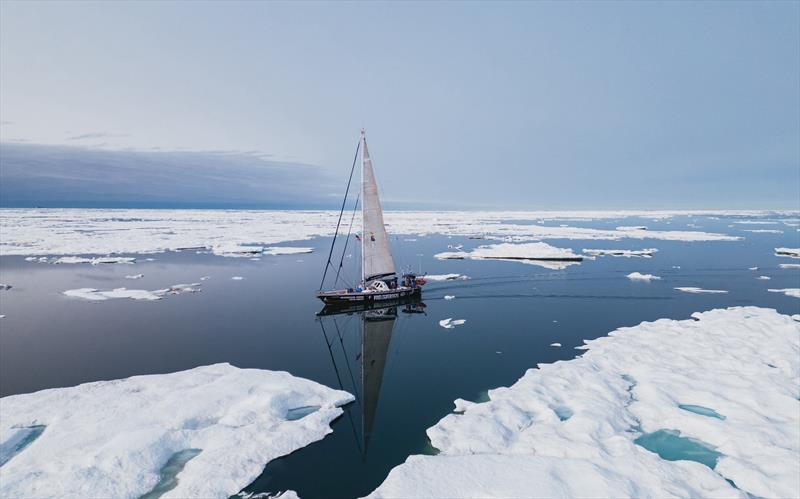
Alegría Marineros enters the Arctic ice after sailing 9,000 nm non-stop from Chile © Vuelta Vertical
After sailing 9,000 nautical miles non-stop —around 17,000 kilometres—from Chile to Alaska with just two people on board, the Spanish expedition has entered the fourth and most uncertain stage of its round-the world voyage between Antarctica and the Arctic. It is now sailing among the ice, north of the Arctic Circle, bound for Greenland.
Almost nine months have passed since Vuelta Vertical set sail from Castellón on 15 November 2025 to take on a very particular round-the-world sailing expedition: to sail from south to north, cross all five oceans, complete the Antarctic stage and then connect with the Arctic through the Northwest Passage, all within a single year of navigation.
Since then, the expedition, led by Pedro Jiménez and Paula Gonzalvo aboard Alegría Marineros, has left behind the Mediterranean, the Atlantic, the Southern Ocean, the Antarctic region, the Indian Ocean and the Pacific from south to north, from Chile to Alaska. It has now reached one of its greatest milestones: entering the Arctic. A completely new environment where success depends on unpredictable factors such as weather conditions and the presence of sea ice.
This fourth stage, after crossing the Bering Strait and sailing through the Chukchi Sea, has now taken them into the Beaufort Sea, north of the Arctic Circle. At present, the crew consists of seven sailors: Pedro Jiménez, captain; Paula Gonzalvo, second in command and responsible for route strategy and planning; David Boquera, Concha Gómez, Juan Sisto, Joseani Octaviani and Juan Pablo Barros.
There are stretches of coastline where the concentration of sea ice creates barriers that are effectively impassable for a sailing yacht. At other times, Alegría Marineros manages to make progress between ice floes through narrow corridors of open water. But those routes can disappear. A change in the wind can shift and compress the ice, closing off within a matter of hours an area that had previously
appeared navigable.
"After crossing the Pacific with just the two of us on board, we barely had time to celebrate what we had achieved. Now we are sailing among the ice, and every day begins with the same question: will there be a way through towards Greenland?" explains Paula Gonzalvo.
The major challenges of this fourth stage
At times, the boat becomes almost completely surrounded by ice. When that happens, one of the crew climbs the mast to search from above for a possible way through the floes. When conditions allow, they also launch a drone to identify potential corridors from the air.
The objective is not to sail through the ice. It is to find open water between the ice. And they sail without knowing whether there will still be a route the following day. The Arctic has also introduced a form of vigilance that had never been necessary during the previous 32,000 miles: keeping watch for bears. The seven crew members maintain continuous watches not only to detect ice and monitor navigation, but also for the possible presence of polar bears, especially when the boat is stopped or close to areas of ice and coastline. Their vigilance, therefore, no longer ends at the bow of the boat.
A labyrinth of islands, straits and channels
The Northwest Passage crosses a complex labyrinth of islands, straits and channels in the Canadian Arctic, connecting the Pacific and Atlantic Oceans. On a map, it appears to be an enormous shortcut. In reality, it remains one of the most unpredictable maritime routes on the planet.
Its navigable window is short, varies from season to season, and depends on the concentration, thickness and movement of the ice. That uncertainty is one of the reasons why, despite the considerable reduction in distance it can offer on certain routes, it has never become established as a major regular commercial shipping route comparable to traditional maritime corridors.
For Vuelta Vertical, that same uncertainty now shapes every day of the expedition. The intention is to continue through the Canadian Arctic, complete the Northwest Passage and eventually reach Nuuk, Greenland. But there is no guarantee they will succeed.
If the ice does not provide a sufficiently safe route, the expedition will have to wait, stop or turn back.
Vuelta Vertical in numbers
- Departure: 15 November 2025 - Castellón, Spain
- Miles sailed so far: 32,197
- Total planned route: approximately 40,000 nautical miles
- Current crew: 7 people
- Current objective: Northwest Passage
- Stage destination: Nuuk, Greenland