
Beyond Assumptions - What Cyclops Load Data Revealed About a Mysterious Dismasting
by Cyclops Marine 2 Oct 13:30 UTC
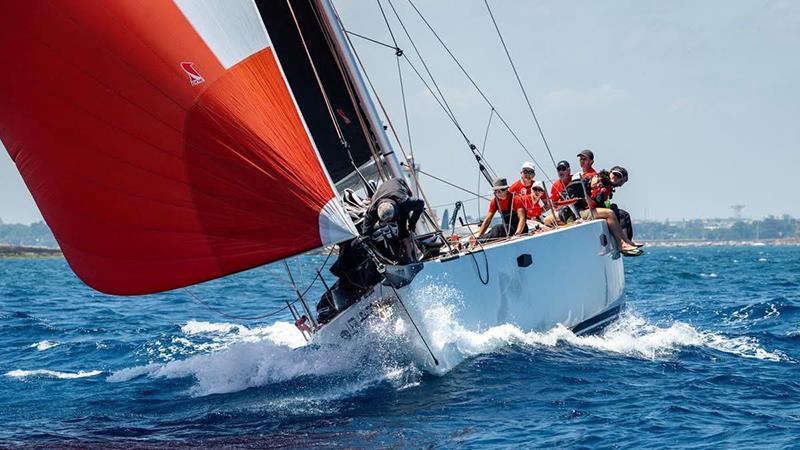
After 'Bloom' was dismasted, load sensor data was of valuable use © Cyclops Marine
The case of 'Bloom' highlights the growing importance of load monitoring in offshore sailing. Data recorded by a Cyclops load sensor demonstrates how objective measurements can lead to conclusions very different from initial assumptions.
A picture-perfect day on the water
In offshore sailing, a dismasting is often associated with extreme conditions, overly aggressive sailing, or loads exceeding the limits of the equipment. The case of the Rimar 45RS 'Bloom', which dismasted during the 2026 Brindisi-Corfu International Regatta, tells a different story.
At the time of the incident, 'Bloom' had sailed approximately 70 nautical miles from the start of the Brindisi-Corfu race and was operating in demanding but entirely normal offshore racing conditions. The maximum recorded true wind speed was approximately 25 knots, while the yacht's maximum recorded speed was only about 15 knots. The boat was sailing on a broad-reach course with waves approaching from the quarter.
The vessel's motion remained fully under control. Heel angles were moderate, the helm remained stable, the boat was properly balanced, sailing under mainsail, A2 gennaker, and staysail. The crew included sailors with many years of high-level competitive sailing experience, including Olympic campaigns.
In such an environment, any significant signs of overload, instability, or mast pumping would likely have been detected and addressed. Nothing suggested an imminent structural failure.
From smooth sailing to sudden failure
At the moment of the dismasting, the vessel was under full control. Four crew members were actively sailing the boat, including the helmsman, mainsail trimmer, tailer, and trimmer. Four crew members were on the windward guardrail to help minimise rolling. Two crew members were below deck in the saloon.
The incident occurred suddenly and without warning. The crew members reported hearing a "bang," immediately followed by the mast falling to leeward.
Data-driven investigation
Thanks to the presence of a Cyclops load sensor installed on the backstay and the continuous recording of sailing data, investigators were able to reconstruct the sequence of events leading to the dismasting with a high degree of accuracy. This empirical data provided a crucial baseline for evaluating both operational parameters and the structural behaviour of the rig.
Moments before the dismasting, the load measured on the backstay was approximately 1,600 kg - just a quarter of the maximum working load limit. Analysis of the data from throughout the race demonstrated that peak loads remained substantially below the 9 tonne working load limit of the backstay system. Had the failure resulted from an extraordinary load event or excessive rig tension, measured forces would typically approach or exceed these limits.
Instead, the data indicates that the rig was operating within those margins under the prevailing conditions. The load sensor data effectively allowed investigators to rule out operational overload as a sole contributing factor.
To narrow down the potential causes, the investigation also evaluated potential dynamic instabilities that could be the cause of structural fatigue, such as mast pumping.
Video footage showed the backstay system remaining stable throughout the race, and no cyclical load variations showed in the data. The crew confirmed these observations, noting no history of pumping during the race or in prior seasons.
Taken together, the load recordings, visual evidence, and crew reports suggest that the root cause was not driven by extreme environmental conditions or boat handling.
Instead, the focus of the investigation shifted toward understanding the complex interactions within the rig assembly, including potential material fatigue, local stress concentrations, or component specification limits that may have contributed to structural failure under moderate loads.
Lessons Learned
The 'Bloom' incident highlights the vital role of real-time load monitoring in modern offshore sailing. While load sensors have historically been used as performance-tuning tools on grand-prix racing yachts, this case underscores their value in safety management and post-incident analysis.
The objective data provided by the backstay load sensor was essential in contextualising the event, isolating operational variables, and guiding subsequent engineering reviews.Had additional load sensors been deployed across the rig over an extended period, they may have revealed subtle, long-term structural trends—prompting earlier inspections and potentially pre-empting the failure.
Building on these valuable insights, the replacement rig will adopt an even more comprehensive approach to load measurement and structural monitoring.
The new carbon-fibre mast is equipped with an integrated mast jack for precise compression management, alongside additional Cyclops smarttune load sensors installed on the cap shrouds. This configuration allows for continuous, real-time monitoring of standing rigging loads and force distribution across the entire rig structure. Ultimately, integrating multi-point load monitoring transforms real-time load data from just a performance metric into a critical safety system, enhancing overall awareness and mitigating future risks.
www.cyclopsmarine.com