Phoenicia is back - now to cross the Atlantic
by Nancy Knudsen on 8 Mar 2013
Phoenician Ship Captain John Jamieson
http://www.skippertips.com
First he set out to circumnavigate Africa in a faithful replica of a Phoenician ship in 2010, and succeeded, proving that Phoenicians probably did it 2600 years ago. Now he's keen to prove that the Phoenicians could have crossed the Atlantic long before Columbus.
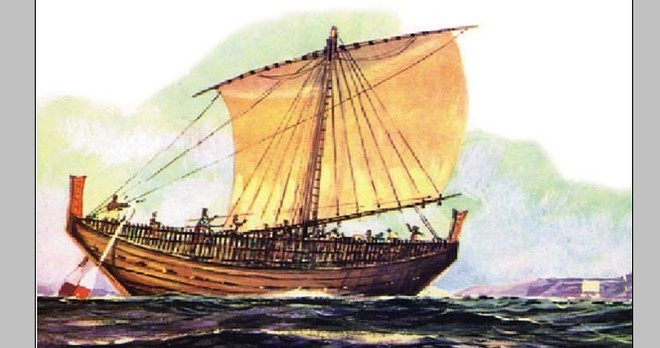
Former Royal Navy officer Philip Beale hopes to sail the same replica Phoenician boat, appropriately called Phoenicia, on a 5000nm voyage across the Atlantic in an adventure which could rewrite our history books.
Christopher Columbus 'sailed the ocean blue' in 1492, and was thought to be the first European to set foot on the 'New World, although these days there's evidence of Viking and other visits much earlier.
The Phoenicians were an ancient Mediterranean civilization who prospered from 1500BC to 300BC. Along with their sophisticated seafaring skills, the Phoenicians were renowned as an intellectual and industrious civilization who helped develop the alphabet we still use today. It was by copying from an ancient shipwreck discovered off the coast of Italy, and inspired by Greek historian Herodotus's writings, that Philip Beale and his supporters built the Phoenica in the first place, seeking to prove just what capable mariners they were.
'If anyone could have done it [crossed the Atlantic before Columbus], it was the Phoenicians,' Beale recently told CNN.
'Of all the ancient civilizations they were the greatest seafarers — Lebanon had cedar trees perfect for building strong boats, they were the first to use iron nails, and they had knowledge of astrology and currents.'
Beale is well used to sailing the Phoenicia, having been her skipper during the circumnavigation of Africa. Setting sail from Syria in 2008, The Phoenician covered 32,000 kilometers over two years, battling everything from six-meter waves off the Cape of Good Hope to Somali pirates.
'We had run the gauntlet of pirate-infested waters, overcome numerous technical problems and traveled deep into the Indian and Atlantic Oceans,' Beale says in the book about the incredible voyage, 'Sailing Close to the Wind'. (See Sail-World http://www.sail-world.com/Cruising/international/Sailing-Close-to-the-Wind---following-Phoenicia-around-Africa/105597!story)
'I had proved she was an ocean-going vessel and when she was coasting along the waves, her sail billowing in the wind; to captain her had been an unforgettable experience.'
The final leg of the journey actually took them wide out across the Atlantic and a mere 500nm off the coast of America. It was here Beale got his inspiration for the journey to the U.S.
'Archeologists have found Egyptian mummies with traces of tobacco and cocaine which could only have come from the New World,' Beale said. 'It indicates there was something going on across the Atlantic.'
In addition to the traces of tobacco and cocaine back in Egypt, Brazil is full of vestiges that corroborate the Phoenician presence in its lands and everything indicates that they concentrated their occupation in the northeastern region. A little away from the Longá and Parnaiba rivers' confluence, in Piaui state, there is a lake where Phoenician shipyards and a harbour with a place reserved to tie the 'Carpássios' (old long traveling ships) were discovered.
By navigating the Mearim river up north, in Maranhão state, when arriving in the Pindaré and Grajaú rivers' confluence we can find the Pensiva lake before known as Maracu. In that lake's borders there can be found shipyards made of petrified wood containing thick nails and bronze dowels. Researcher Raimundo Lopes, born in Maranhão State, excavated that location at the end of the twenties and discovered typically Phoenician tools.
In Rio Grande do Norte state, after roaming a 11 km canal, the Phoenician boats used to anchor in the Extremoz lake. The Austrian professor Mr. Ludwig Schwennhagen studied the place's subterranean parts and the embankments carefully and also some others that exist near the village of Touro where the Phoenician navigators anchored after roaming about 10 km of a canal. The same professor Schwennhagen tells us that he found Phoenician inscriptions in the Amazon in which there were references to many kings of Sidon and Tyre (887 to 856 BC).
Schwennhagen believes that the Phoenicians used Brazil as a base during 800 years at least, leaving there, besides material evidences, an important linguistic influence among the natives.
Setting off from Tunisia, the Phoenicia is expected to take two to three months to reach America. However, the biggest challenge may not turn out to be high seas and ferocious winds. Philip Beale must first raise approximately $156,000, or about £100,000, for the expedition.
If you want to link to this article then please use this URL: www.sailworldcruising.com/107281