
Mote scientists identify disease-resistant corals that could strengthen future reef restoration
by Mote Marine Laboratory & Aquarium 15 Jul 18:07 UTC
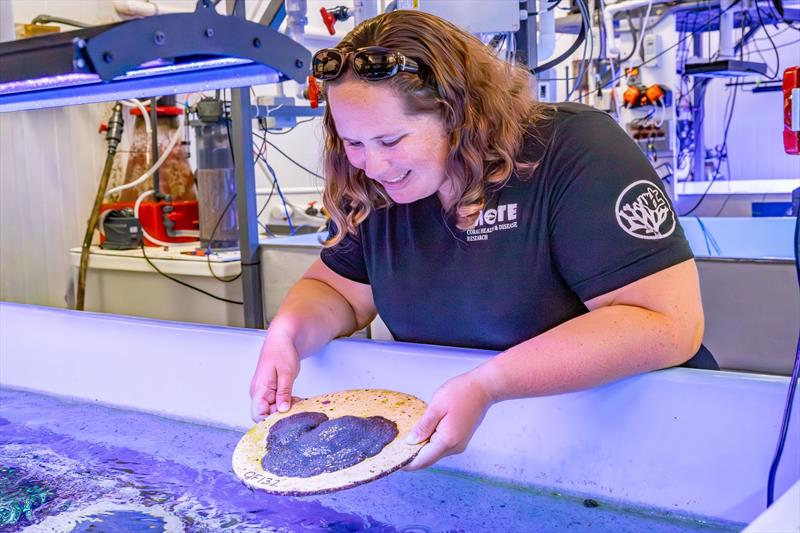
Dr. Sara Williams at Mote's International Coral Gene Bank © Mote Marine Laboratory & Aquarium
Scientists from Mote Marine Laboratory and collaborating institutions have completed the largest laboratory transmission experiment to date for stony coral tissue loss disease (SCTLD), identifying naturally disease-resistant mountainous star coral (Orbicella faveolata) genotypes that could help strengthen restoration efforts and future coral reef restoration strategies.
Since it was first identified near Miami, Florida, in 2014, SCTLD has spread throughout Florida's Coral Reef and much of the Caribbean, causing extensive mortality across nearly half of the region's reef-building coral species. Understanding why some corals naturally resist the disease is a critical step toward developing more resilient coral populations for restoration.
In the newly published study, "Restoration stocks of a Caribbean coral species contain low levels of inherent stony coral tissue loss disease resistance" (Scientific Reports 2026), Mote researchers evaluated disease susceptibility of 154 genetically distinct mountainous star coral genotypes maintained within Mote's Coral Reef Restoration Research Program. Through four sequential laboratory transmission experiments, they assessed how individual corals responded after exposure to SCTLD, one of the most destructive coral diseases ever documented.
Mountainous star coral is a major Caribbean reef-building species and is highly susceptible to SCTLD, making it a priority for restoration efforts. During Mote's laboratory transmission experiments, scientists monitored corals after exposing them to stony coral tissue loss disease (SCTLD) and collected over 2,500 samples to better understand why some corals become infected while others do not. The corals were then classified into four disease-response categories based on the severity and progression of tissue loss. By studying the corals that remained healthy despite exposure, researchers are identifying traits that may help explain their natural resistance to the disease.
The research team then compared the laboratory results with the performance of coral colonies that had previously been outplanted onto reefs in the Lower Florida Keys during the initial outbreak phase of SCTLD. Several of the disease-resistant genotypes also experienced lower disease risk following outplanting, suggesting that laboratory disease assessments may help identify resilient corals for future restoration efforts.
While most genotypes were susceptible to SCTLD, researchers identified 12 with multiple experimental replicates that consistently demonstrated disease resistance throughout the transmission experiments. Mote's science-based restoration efforts on Florida's Coral Reef strategically integrate corals with known disease-resistance. By propagating and outplanting more of these naturally resistant corals, we can help build healthier, more resilient reef ecosystems for the future.
"This project represents years of collaboration and one of the most comprehensive efforts to understand how an important reef building coral species responds to stony coral tissue loss disease," said Dr. Sara Williams, lead author and staff scientist in Mote's Coral Health and Disease Research Program. "Evaluating more than 150 genetically distinct individuals allowed us to identify patterns of disease resistance."
Mote researchers caution, however, that disease resistance alone does not determine long-term restoration success. Survival of outplanted corals is influenced by many factors, including environmental conditions and other biological stressors. The study concludes that evaluating multiple traits, including disease resistance, will likely improve the selection of corals for restoration programs.
"Restoration efforts must increasingly focus on building diverse and resilient coral populations as Florida's Coral Reef continues to face unprecedented challenges," said Dr. Williams. "Identifying and incorporating disease-resistant corals into restoration programs is one important step towards long-term reef recovery and ecosystem resilience."
Although naturally disease-resistant mountainous star corals are present within current restoration populations, the study found they represent only a relatively small proportion of available genotypes. The ongoing work to identify a biological marker for SCTLD resistance can be used to screen future genotypes for disease-resistant traits without having to conduct additional large-scale transmission experiments. Expanding efforts to identify, preserve, and propagate corals with beneficial traits, including disease resistance, may improve the long-term resilience of restored reefs.
"Mote's mission is to develop innovative, science-driven solutions that address the growing challenges facing our oceans," said Dr. Michael P. Crosby, President & CEO of Mote Marine Laboratory. "This research represents an important step forward in our efforts to strengthen coral reef restoration through science. By improving our understanding of natural disease resistance in corals, studies like this provide critical knowledge to help restoration practitioners build more resilient reefs for future generations."
The study was led by scientists from Mote Marine Laboratory in collaboration with researchers from NOAA's Atlantic Oceanographic and Meteorological Laboratory, the University of Miami, Stony Brook University, and additional partner institutions.
Funding was provided by Florida's Department of Environmental Protection through the Coral Protection, Restoration Grant Award No. C2002 & Award No. C1FB43, and Florida Fish and Wildlife Conservation Commission Contract No. 17176.
The full study, Restoration stocks of a Caribbean coral species contain low levels of inherent stony coral tissue loss disease resistance, was published in Scientific Reports, 2026 and is available here.